
The High Priestess Tarot Card and Persephone
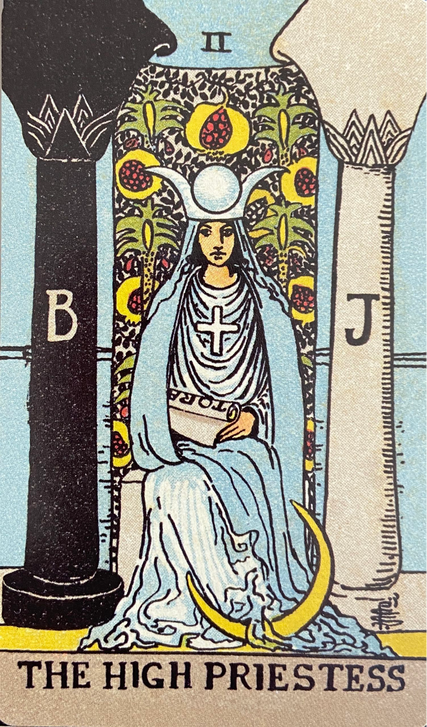
From the Smith-Waite Tarot Deck
The High Priestess – Persephone – Queen of the Underworld
In the High Priestess card of the Rider-Waite Tarot deck, we see fertility symbols on the veil behind her and this brings to mind the connection between the High Priestess and Persephone, or Proserpine, of Greco-Roman mythology.
Most stories about Persephone tell us how she was kidnapped by Hades, god of the Underworld. Persephone was the daughter of Demeter, goddess of the Harvest, and she was young and fresh and so beautiful that Hades fell in love with her. He knew her earthbound, devoted mother wouldn’t hear of her daughter ruling in the Underworld, and so, in desperation, he took her away, usually, it’s said, on his black chariot.
Persephone herself was more than just a beautiful girl; she was the goddess of spring, and was so beloved by her mother that when she disappeared, her Mother became deeply depressed and suddenly winter came to the world, killing all the crops.
When Zeus, king of the gods, saw what had happened, he agreed with Demeter that Persephone should leave the Underworld, an idea Persephone probably liked, since while she was there, she refused to rejoice or eat anything. Well, almost anything. So much time had passed and she was so hungry that she ate six pomegranate seeds. Because of this, she could never fully return to the world.
A compromise was reached: she would spend six months of every year in the Underworld – one month for each of the pomegranate seeds she’d eaten. It’s said that this is why there are seasons like autumn and winter, when little grows: this is when Persephone is in the Underworld.
But there is a duality to Persephone, a duality we also see in the High Priestess. In many ancient cultures, Persephone was primarily thought of as the Queen of the Underworld. We don’t know what her feelings were about this, but for the Greeks, the Underworld wasn’t considered a joyful place, and Persephone may not be considered happy there. And yet, there are no accounts of her trying to escape once the matter of the pomegranate seeds settled everything.
Like the High Priestess, she is at once full of womanly energy, fertile like the earth and the spring, and at the same time, she is the embodiment of detachment. She is resigned to her fate as Queen of the Underworld, ruling in a quiet place (Greek spirits couldn’t speak), and very dignified on her throne.
This same quiet, watchful energy is also why the High Priestess is the guardian card for Imbolc on the Wheel of the Year — the season of the first, unseen stirrings of spring, long before there's any proof they're coming.
What do you make of it?