Brigid, Goddess of Imbolc: The Meaning Behind Brigid's Cross
The Meaning Behind Brigid's Cross
If you were at Cindy's on the 9th, you already met her, even if nobody said her name out loud. Brigid's the one who got us moving again after winter — the goddess I chose to sit with for this Imbolc retreat, and the reason the whole morning had that particular "waking up gently, rather than waking up with a thump" energy to it.
Here's who she is, why she matters at this point in the Wheel, and what that woven cross you've seen in half the celtic imagery actually means.
So Who is Brigid?
Brigid isn't a one-note goddess. In the old Celtic tradition she's a triple goddess — three sisters who share the one name, or one goddess wearing three faces, depending on who’s telling the story. She holds fire (the hearth flame, the forge), poetry ( inspiration for the spoken and written word), and healing (the waters of the well, the body, and the mending of things). She is Keeper of the flame, keeper of the word, keeper of the wound. That's a lot of ground for one goddess to cover, and it's exactly why she was the right fit for our Imbolc retreat in August. Imbolc's the point on the Wheel where we're not asking for a miracle, we're asking for a spark. Something small, tended, honest and real. That’s Brigid's whole thing.
At Kildare, nineteen priestesses were said to keep her sacred flame alive, each tending it in turn, day after day — and on the twentieth day, it is said that Brigid herself tended it. Whether you take that literally or not, there's something worth noting here. The fire doesn't go out because everyone shows up to keep it lit. It’s about community - and that's Imbolc energy too.
In the Southern Hemisphere, we mark Imbolc in early August, and it's literal — we're actually in it. Winter is loosening its grip, the light is returning, the ground is starting to soften. This is when Brigid gets to work, coaxing life up through the cold.
The cross — and why it's everywhere near her name
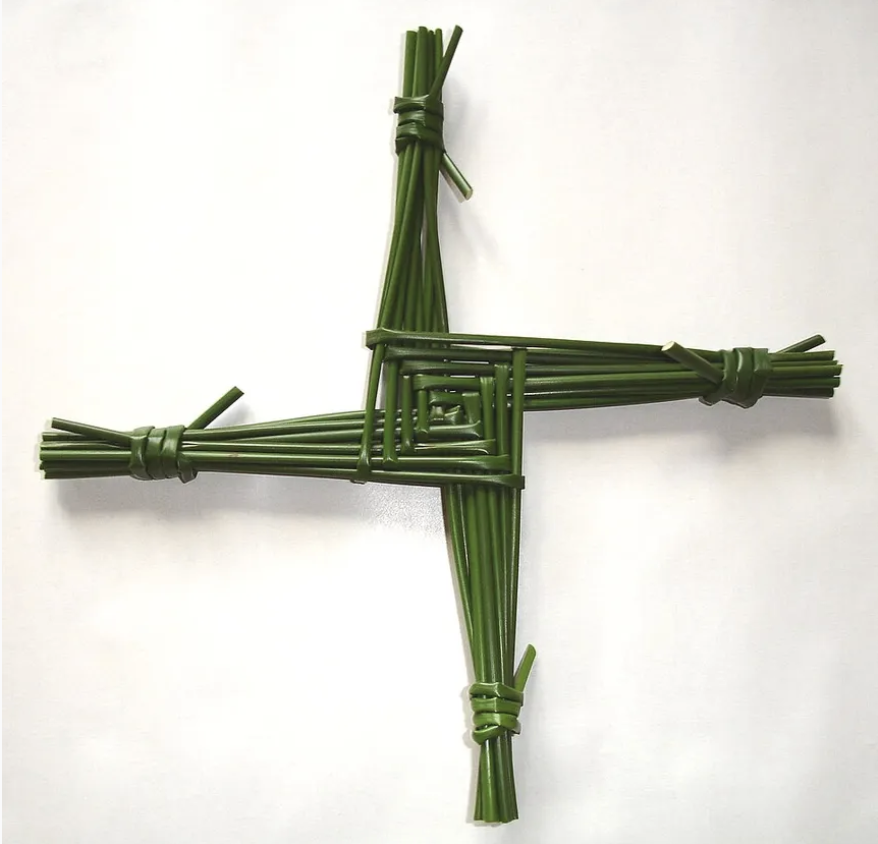
You've seen it — the small woven cross, four arms, a little pinwheel at the centre, usually made from straw or rushes. It shows up at Imbolc, on St Brigid's Day, and in places like this gorgeous Irish Shop. Here's the layered story behind it, because it is genuinely layered, not just decorative.
The cross predates its Christian name. Long before it was "St Brigid's Cross," that woven shape carried sun-wheel associations — arms radiating from a centre, echoing the wheel of the sun and, not coincidentally, the wheel of the year itself. It was made from rushes gathered fresh, folded and wrapped by hand, and hung over the doorway or above the hearth for protection. Protection from fire, from want, from whatever the household needed kept out that year.
Then Brigid the goddess and Brigid the saint merged into each other, the way so much pre-Christian belief did. She wasn't the only one — across many cultures, goddess after goddess was quietly re-cast as a saint, a way for the Church to bring the old religion, and the people still loyal to it, into line without having to tear it out by the roots.
The most told version of the cross's origin has Saint Brigid weaving it at the bedside of a dying pagan chieftain, using it to explain her faith to him as he passed. A bridge story, literally woven. But the shape she used, the rushes, the doorway tradition — that's older than the story explaining it. The saint didn't invent the symbol. She was handed something already sacred and given a new way to talk about it.
That's the honest version: goddess and saint, pagan protection charm and Christian teaching tool, sitting inside the same four woven arms. You don't have to pick a side to hang one over your own door. Most people who do aren't choosing a religion — they're choosing to mark the turn of the season and ask, quietly, for their home to be watched over and cared for.
What we actually did with all this
None of that stayed theoretical on the day. We used some music and movement to shake off what winter had left sitting in the body, meditation and journalling to get honest about what actually needs tending going into spring — not a vision-board wish-list, just the real, small, doable version of a spark. Someone said it, and then someone else added to it, a consensus seemed to form, it was about not rushing and how that gets you into the flow.
That's the retreat in one line, really: not a dramatic reinvention, just clearing enough stagnant energy to let something real get lit, so that each one of us could get into our flow.
What's still to come
Imbolc was the beginning point for us with this journey with the wheel, not the whole thing. Four more half-day retreats are scheduled in through to next August, each one tracking the next turn of the season:
Beltane — Sunday November 8, celebrating vitality and getting back into the body through movement and cards.
Lammas — Sunday January 31, honouring the first harvest and actually practising gratitude instead of just saying the word.
Samhain — Sunday May 2, releasing what needs releasing and sitting with the ancestors and the thinning veil.
Imbolc - Sunday August 1st, clear stagnant energy, and plant fresh intentions.
We’ll be using a similar format each time: yoga, breath-work, meditation, cards, journaling, its three delicious, unrushed hours at Cindy's Yoga Studio in Wodonga. Three hours for you.
If you felt something shift on the 9th, or you're reading this wishing you'd been there, you can book into all four of the forthcoming retreats in one hit — and if you do that by October 1st, there’s a special discount, the full Wheel of the Year for $270 (that's 10% off booking the four separately at $75 each). Link's here if you want to book into all four retreats and do the whole year with us. If you’d like to pick and choose click here to take a look and opt in individually.
Don't overthink it. The Wheel keeps turning whether you show up or not — might as well show up.