
Olwen: The Welsh Goddess of Beltane & Spring
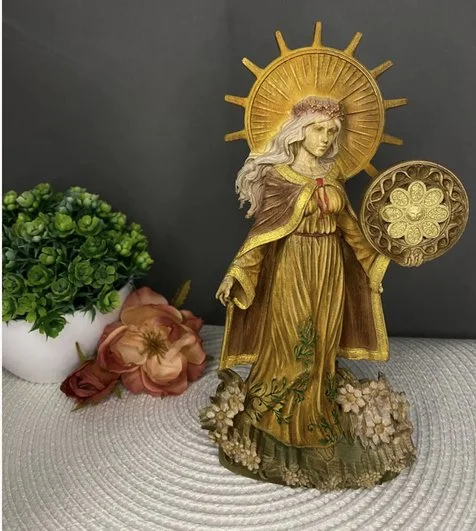
Olwen
Olwen: The Beltane Goddess
Every sabbat has a figure standing quietly at its centre, and for Beltane, mine is Olwen.
She's not one of the better-known names in Celtic myth — no grand temples, no widespread modern cult the way Brigid has. But once you know her story, it's hard to imagine a better fit for this particular fire festival.
Who Olwen Is
Olwen comes to us from Welsh mythology, most fully told in the tale of Culhwch and Olwen, one of the oldest surviving Arthurian stories, tucked into the collection known as the Mabinogion. She's the daughter of a giant, Ysbaddaden Bencawr, and she is, by every account, staggeringly beautiful — her skin as white as sea foam, her hair more golden than broom flowers, her cheeks pinker than the loveliest foxglove.
But the detail that matters most for our purposes is this: wherever Olwen walked, four white trefoils sprang up in her footsteps. Her very name is usually translated as "white track" or "she who leaves a white path" — the world quite literally blossoming behind her as she moves through it.
The young hero Culhwch falls in love with her before he's even met her, purely on hearing her name spoken aloud, and sets out to win her hand. Her father, bound by prophecy to die the day she marries, sets Culhwch a seemingly impossible string of tasks to complete first — and with help from Arthur's court, he does. Olwen and Culhwch are wed, and the giant's fate plays out as foretold.
Why She Belongs to Beltane
Beltane is the sabbat of things blossoming into being — passion, creativity, union, life at its most visibly alive. Olwen is that principle given a face and a footstep. She doesn't cause spring to arrive through effort or spellwork; flowers simply appear because she is present, because she is moving through the world as herself. There's something worth sitting with in that alone — the idea that growth doesn't always need to be forced or worked for. Sometimes it just follows naturally from showing up fully as you are.
Her story also carries Beltane's other great theme: sacred union, arrived at through devotion rather than ease. Culhwch doesn't win Olwen by chance — he commits, wholeheartedly, to tasks that ask everything of him, long before he knows the outcome. That's Beltane's fire in a nutshell: not a passive wish for things to bloom, but a willingness to say yes and follow through once you have.
Walking With Olwen
You don't need a Welsh castle or a giant's blessing to borrow a little of her energy this season. It's less about doing something specific and more about noticing: where in your own life might beauty be following you, quietly, if you let yourself walk through it fully present rather than rushing past? What might already be blossoming in your footsteps that you haven't stopped to see?
She's a gentle reminder that Beltane's abundance isn't always loud. Sometimes it's simply there, underfoot, waiting to be noticed.
Meet Her Properly
This is really just the introduction. Olwen holds a much bigger place in the Beltane — High Spring retreat, where her story becomes part of a guided journey rather than just something read on a page. If you'd like to spend real time in her company — Tarot, ritual and story, held together with a small group — details and booking are here.
— Karen